Mailtrap does two different jobs. Its Email Sandbox catches the email your app sends while you build it, so nothing reaches a real person. Its Email Sending product delivers email to real people. Most "Mailtrap alternative" searches are about one of the two, and the best replacement depends on which.
This guide is for developers who send email from an app, including apps built with a coding agent. It covers seven alternatives in three groups: sandboxes, a pre-send check of real inbox placement, and sending APIs. We checked every price and limit on each vendor's own page on 18 November 2026.
TL;DR
- Best free sandbox you run yourself: Mailpit. One binary or Docker image, with a web inbox, an API and a spam check.
- Best hosted sandbox for automated tests: Mailosaur, from $20 a month billed yearly.
- Best throwaway sandbox for Node apps: Ethereal. Free, and Nodemailer can create an account in one call.
- Best for checking where real email lands before you send: Unspam. A free plan each month, then pay per test.
- Best testing API with inbox placement built in: MailSlurp, from $49 a month.
- Best sending APIs: Postmark for transactional email, Resend for a generous free tier.
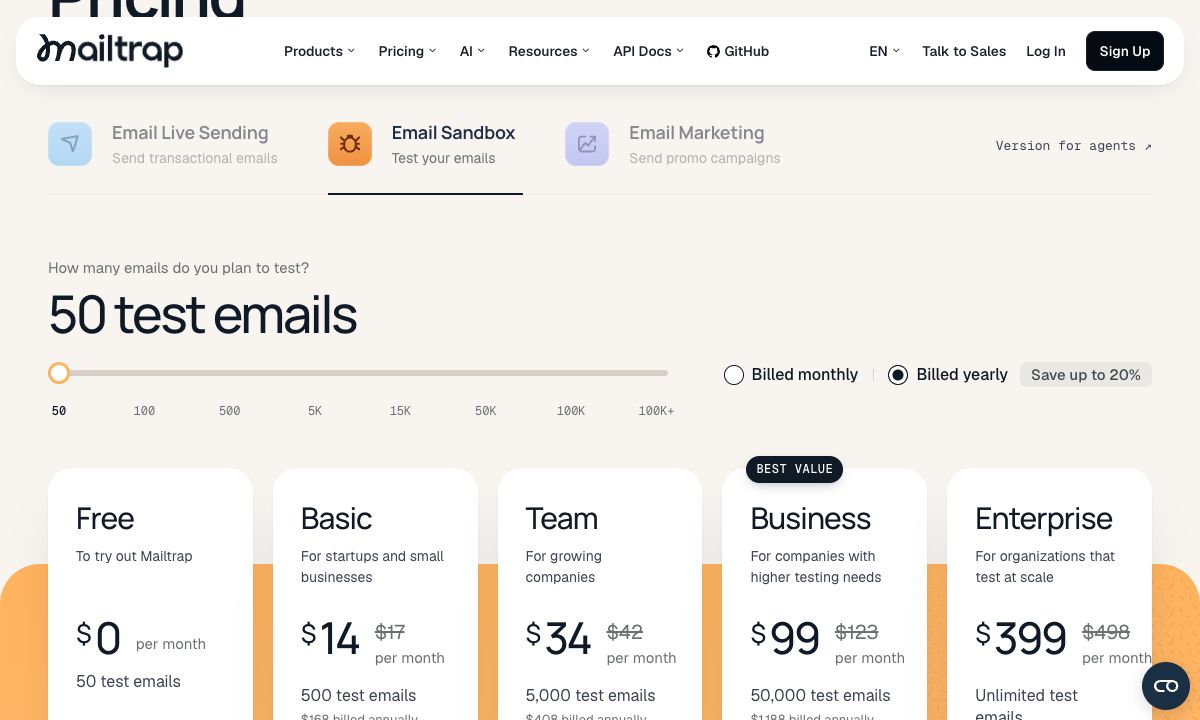
What Mailtrap costs in 2026
Email Sandbox:
| Plan | Monthly | Yearly, per month | Test emails a month | Users |
|---|---|---|---|---|
| Free | $0 | $0 | 50 | 1 |
| Basic | $17 | $14 | 500 | 3 |
| Team | $42 | $34 | 5,000 | 5 |
| Business | $123 | $99 | 50,000 | 50 |
| Enterprise | $498 | $399 | Unlimited | Unlimited |
Every sandbox plan includes an HTML check, a spam analysis, a blacklist report, an API, a command-line tool and an MCP server. Device previews are "available on request" on paid plans. The free plan has one sandbox that holds 10 emails.
Email Sending: free for 4,000 emails a month, at most 150 a day. Basic is $15 a month ($12 billed yearly) for 10,000 emails. Business is $85 a month ($68 yearly) for 100,000, with a dedicated IP. Enterprise is $750 a month ($600 yearly) for 1.5 million.
Why people look for an alternative
- The free sandbox is small. 50 test emails a month, and 10 in the sandbox at a time, run out fast in a test suite.
- A sandbox is not an inbox. It shows what your app sent. It cannot tell you whether Gmail would put that email in the inbox, the promotions tab or spam.
- They want sandbox and sending from different vendors, or one of the two only.
Mailtrap alternatives at a glance
| Tool | Job | Free plan | Paid from | Best for |
|---|---|---|---|---|
| Mailpit | Sandbox | Free, self-hosted | No paid plan | Local development |
| Mailosaur | Sandbox | 14-day trial | $20 a month, billed yearly | Automated end-to-end tests |
| Ethereal | Sandbox | Free | No paid plan | Quick tests from Node |
| Unspam | Pre-send inbox placement | 21 tests a month | $5 monthly minimum, pay per test | Checking real inboxes before a send |
| MailSlurp | Sandbox and inbox placement | Free trial | $49 a month | Test API plus placement in one bill |
| Postmark | Sending | 100 emails a month | $15 a month | Transactional email |
| Resend | Sending | 3,000 emails a month | $20 a month | A free tier you can ship on |
Sandboxes: catch test email before it reaches anyone
1. Mailpit: best free sandbox you run yourself
Mailpit is an SMTP server and web inbox for development. You run it on your machine or in CI from a single binary or a Docker image, point your app's SMTP settings at it, and every email lands in its web interface. It has an HTML compatibility check for common email clients, a link checker, a spam test with SpamAssassin or Rspamd, a screenshot generator, a REST API for tests, and a "chaos" option that makes the SMTP server fail on purpose.
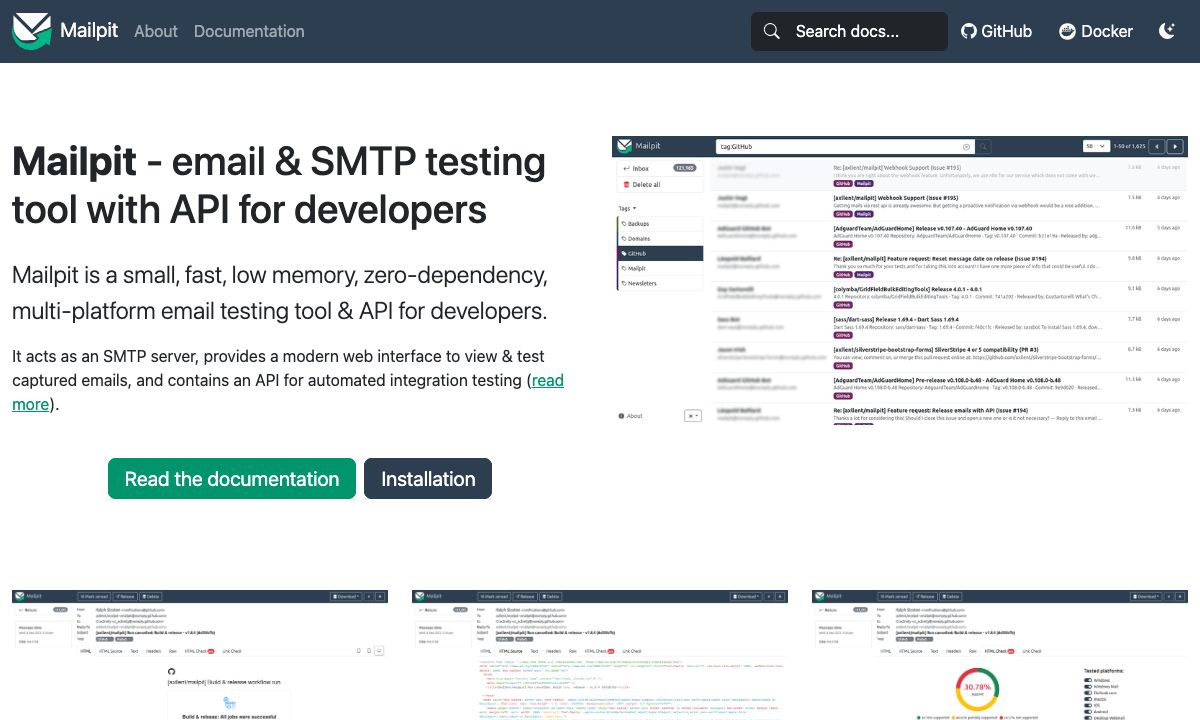
Pricing: free. There is no hosted plan.
Limitations: you host it, so you keep it running. It shows what your app sent, not where a real provider would deliver it. Its home page lists Mailtrap among its sponsors.
Good for: every developer who sends email from a local app. It is the closest free match for Mailtrap's sandbox.
2. Mailosaur: best hosted sandbox for automated tests
Mailosaur gives you hosted inboxes with their own domain, so a test can use any address on it. It is built for end-to-end tests that sign up a user, read the email, and click the link. It also tests SMS and one-time codes.
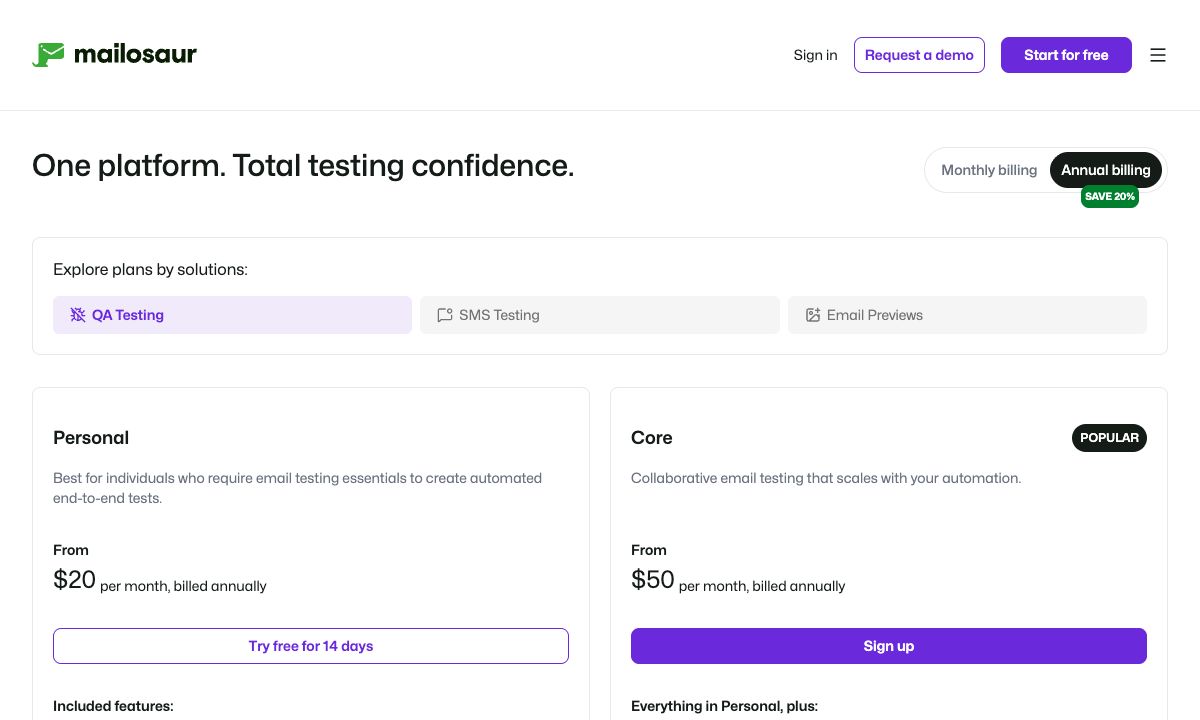
Pricing: Personal is from $20 a month billed yearly, for one user and from 15,000 inbound emails a month. Core is from $50 a month billed yearly, with 5 seats and from 75,000 emails a month. SMS testing is from $37.50 a month and email previews from $25 a month. Yearly billing saves 20%. There is a 14-day trial.
Limitations: no free plan. It tests what your app sends, not inbox placement.
Good for: QA teams with sign-up, password-reset and two-factor flows in their test suite.
3. Ethereal: best throwaway sandbox for Node apps
Ethereal is a free fake SMTP service. Nothing you send through it is delivered. It is made mainly for Nodemailer and EmailEngine users: nodemailer.createTestAccount() gives you SMTP details with no sign-up, and each message gets a preview link.
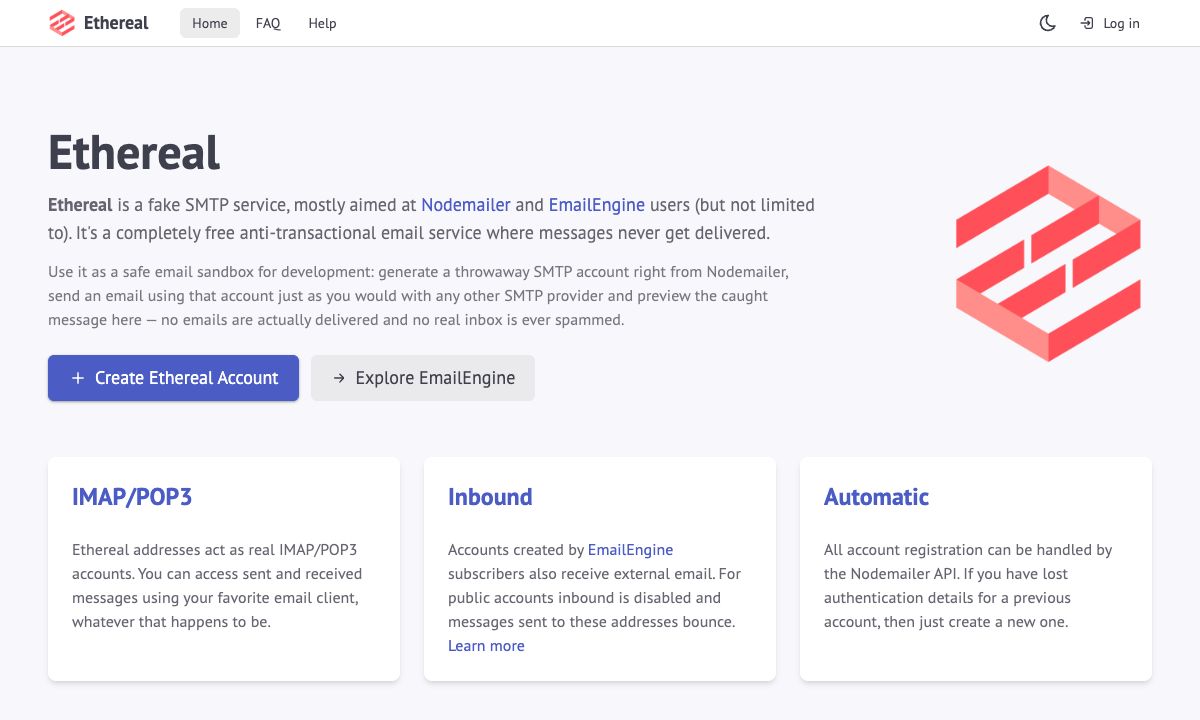
Pricing: free.
Limitations: it only catches and shows messages. Its home page lists no HTML or spam checks, and says it is mostly aimed at Nodemailer users.
Good for: a quick look at what a Node app sends, with nothing to install.
Before you send: check where real email lands
4. Unspam: best for checking inbox placement before a send
Unspam does what a sandbox cannot. It sends your real email to a seed list of inboxes at Gmail, Outlook, Yahoo and others, then reports where each copy landed: inbox, promotions, spam or missing. It also scores a message against spam signals, including SPF, DKIM and DMARC authentication, renders previews in 60+ email clients and devices, takes screenshots, and draws an attention heatmap. It has a REST API and an MCP server, so a test can run from your CI or from a coding agent.
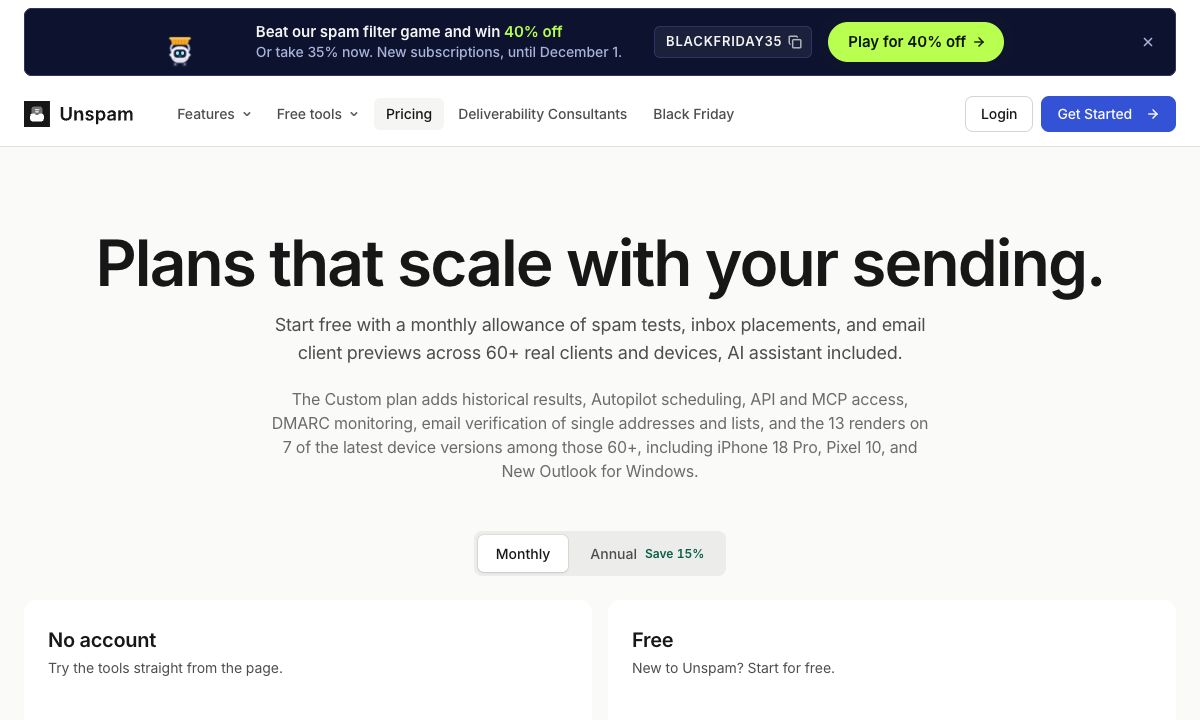
Pricing: without an account you get 3 spam tests, 2 inbox placements and 1 device preview a month. The free plan gives 21 tests a month: 5 spam tests, 3 inbox placements, 3 device previews, 5 screenshots and 5 heatmaps. The Custom plan is pay per test from a $5 monthly minimum: $0.18 a spam test, $0.50 an inbox placement and $0.10 a device preview. Annual billing takes 15% off, and every paid plan has a 14-day refund.
Limitations: it is not a sandbox. It tests email you are about to send for real, not mail from your local app. The API, the MCP server and DMARC monitoring need the Custom plan. It finds problems but does not warm up a sender or fix a blocklisting. And the largest preview tools cover more clients than its 60+.
Good for: developers who already have a sandbox and want to know, before a launch or a big send, whether their email reaches the inbox.
5. MailSlurp: best testing API with inbox placement built in
MailSlurp sells two products. One is an email and SMS testing API, like Mailosaur. The other covers client previews, inbox placement and sender warm-up.
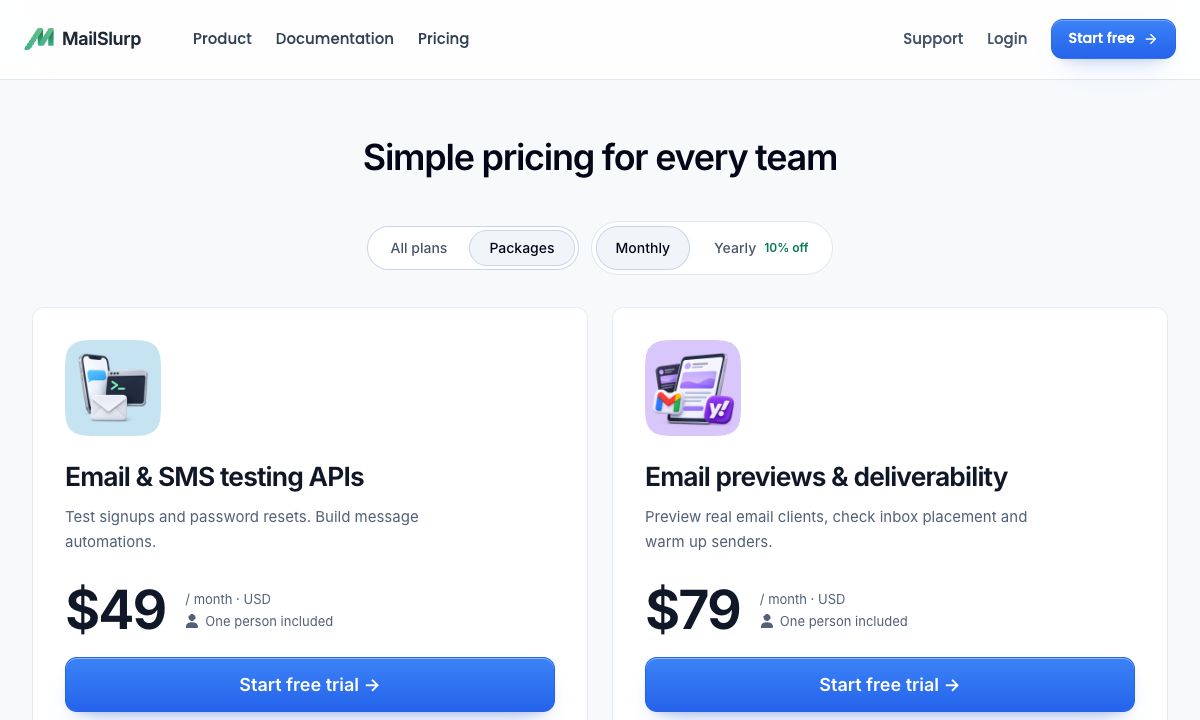
Pricing: the testing API is $49 a month for one person, with 5,000 received emails and 500 external sends. Previews and deliverability is $79 a month, with 100 client previews and 25 inbox placement tests. Both together are $128 a month. Yearly billing takes 10% off. Beyond the allowance, an inbox placement test is $1.
Limitations: the entry price is higher than the others here, and extra people are $25 a month each.
Good for: a team that wants a test API and placement checks from one vendor and one bill.
Sending: if you used Mailtrap to deliver email
6. Postmark: best for transactional email
Postmark sends transactional email: receipts, password resets, sign-in links. It keeps transactional and bulk email in separate streams.
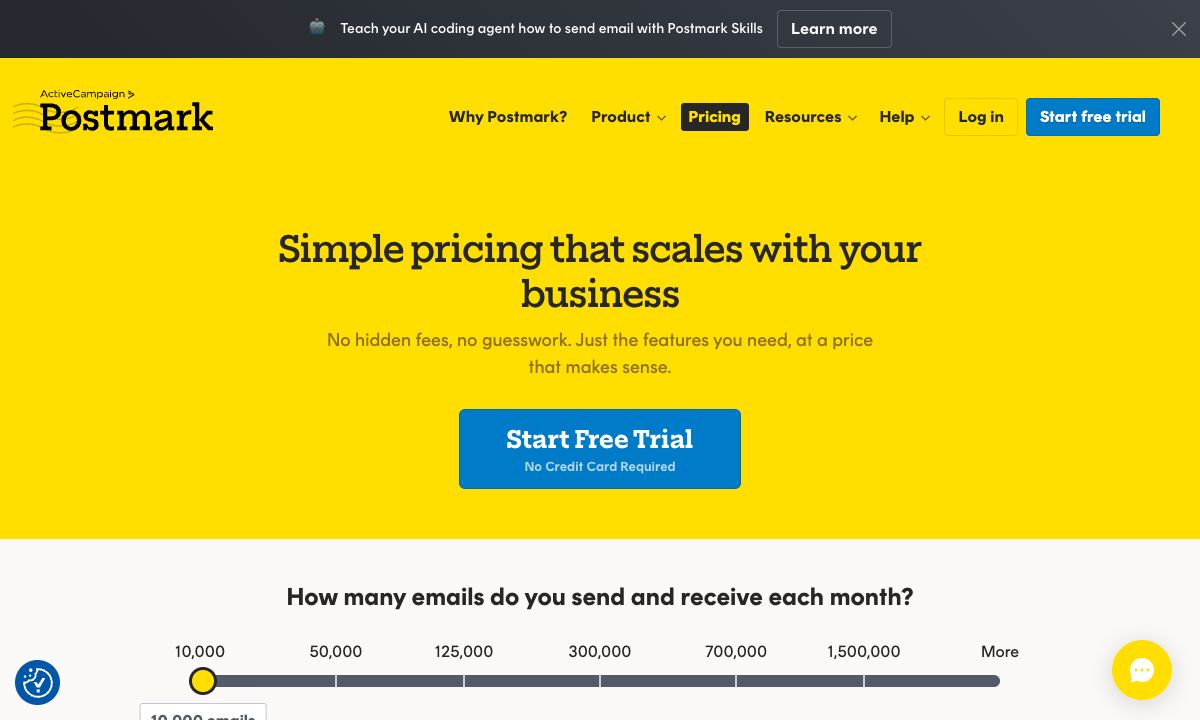
Pricing: the free developer plan sends 100 emails a month and never expires. At 10,000 emails a month, Basic is $15, Pro is $16.50 and Platform is $18. Extra emails cost $1.80, $1.30 and $1.20 per 1,000 on those plans.
Limitations: the free plan is for testing an integration, not for running a product.
Good for: apps where a password-reset email must arrive quickly.
7. Resend: best free tier for sending
Resend is an email API for developers, with transactional and marketing email.
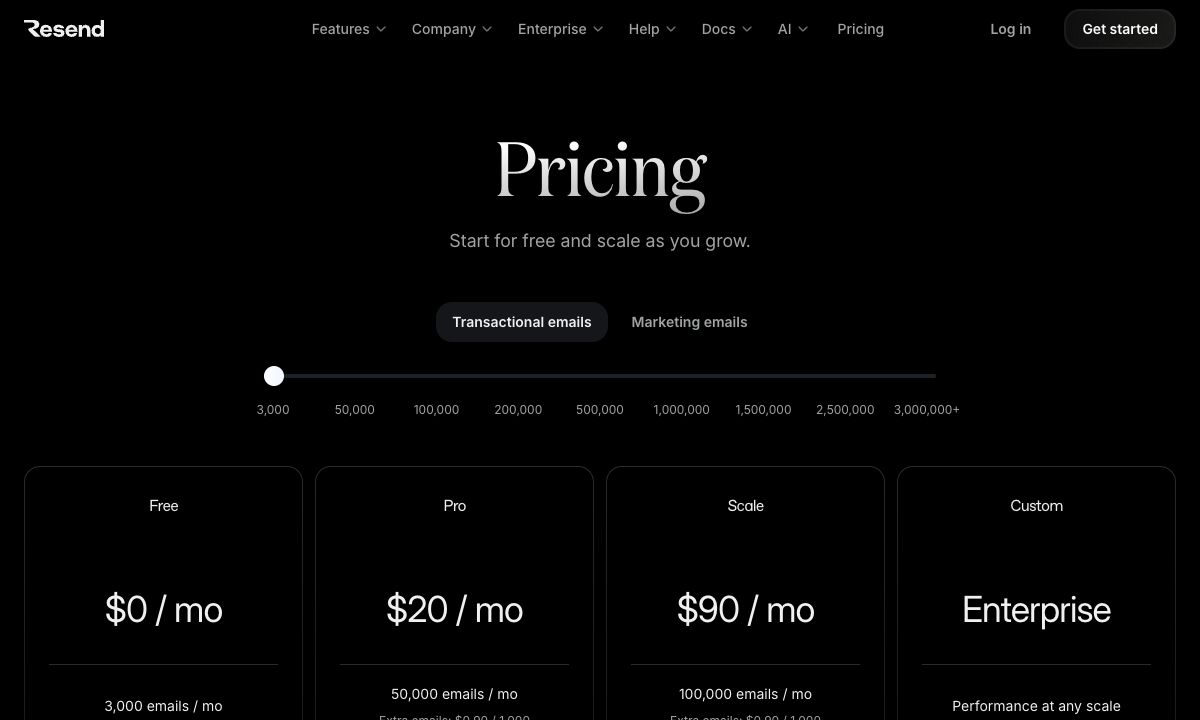
Pricing: free for 3,000 emails a month, at most 100 a day, on 3 domains. Pro is $20 a month for 50,000 emails. Scale is $90 a month for 100,000. Extra emails are $0.90 per 1,000 on paid plans.
Limitations: the free plan's 100-a-day cap. A dedicated IP is a $30 a month add-on, and only on Scale above 3,000 emails a day.
Good for: a new product that wants to start sending for free.
Which Mailtrap alternative should you choose?
- You need a sandbox for local development: Mailpit. It is free and does most of what Mailtrap's sandbox does.
- Your test suite signs up users and reads their email: Mailosaur, or MailSlurp's testing API.
- You want a test email from Node in one line: Ethereal.
- You want to know if email lands in the inbox before a launch: Unspam's free plan, then pay per test.
- You want testing and placement on one bill: MailSlurp.
- You need to send transactional email: Postmark, or Resend if a free tier matters more.
Many teams use two of these: a sandbox while they build, and a placement check before they send. If your email uses your site's colors, carry your design tokens into HTML email shows how to keep the two in step.
FAQ
What is the best free Mailtrap alternative?
For a sandbox, Mailpit. It is free, runs on your machine or in CI, and has a web inbox, an API and a spam check. Ethereal is a free hosted option for Node apps.
Is Mailtrap free?
It has free plans. The Email Sandbox is free for 50 test emails a month, with one sandbox that holds 10 emails. Email Sending is free for 4,000 emails a month, at most 150 a day.
Does Mailtrap test inbox placement?
Its sandbox checks HTML, runs a spam analysis and reports blacklists. It does not send your email to real inboxes to see where it lands. For that you need a seed-list test, such as Unspam's inbox placement or MailSlurp's.
What is the difference between a sandbox and an inbox placement test?
A sandbox catches email from your app so it never reaches a real person. It shows what you sent. An inbox placement test sends real email to real inboxes at Gmail, Outlook and others, and reports whether each copy reached the inbox, promotions or spam.
Can a coding agent run email tests?
Yes, with tools that have an MCP server. Mailtrap's sandbox plans include one, and Unspam's Custom plan includes one with tools for spam checks, inbox placement and previews.
What is a good Mailtrap alternative for sending email?
Postmark for transactional email, from $15 a month at 10,000 emails. Resend if you want a larger free tier, with 3,000 emails a month.