Your app depends on services you don't run: a payment provider, an email API, a cloud host, an AI model. When one of them has an incident, your app breaks, and your team may spend an hour debugging code that was never the problem. Dependency monitoring fixes that. A tool watches the official status pages of the services you rely on and tells you when one of them opens an incident.
StatusGator and IsDown are the two best-known tools built only for this. This guide covers them and three alternatives: an uptime monitor that adds dependency monitors to its plans, and two status page tools that can show a provider's status on your own page. We checked every price and limit on each vendor's own pages on 25 November 2026.
TL;DR
- Best value if you also need uptime monitoring: Pulsetic. Dependency monitors come with its uptime plans, from 1 on the free plan to 30 on the $49 plan, and extra ones cost $0.20 each a month.
- Best for the largest catalogue and early warnings: StatusGator. It tracks 13,060+ services and can alert you before a provider updates its status page. Paid plans start at $79 a month.
- Best dedicated aggregator for a small team: IsDown, from $27 a month for 15 vendors, with a 14-day trial and no free plan.
- Best if you mainly want providers shown on your status page: StatusPal from $99 a month, or Atlassian Statuspage's third-party components.
What dependency monitoring does, and what it doesn't
A dependency monitor reads a provider's public status page and turns its updates into alerts. It answers one question fast: is this them or us?
It has two limits worth knowing:
- It only knows what the provider reports. If the provider has not posted an incident yet, a status page monitor sees nothing. StatusGator's Early Warning Signals try to close that gap with user reports and other signals.
- It does not check your own app. For that you still need an uptime monitor on your own URLs and APIs.
StatusGator alternatives at a glance
| Tool | What it is | Services in its catalogue | Free plan | Paid from | Best for |
|---|---|---|---|---|---|
| Pulsetic | Uptime monitoring with dependency monitors | 4,300+ | 1 dependency monitor | $9 a month for 3 | Teams that want uptime and dependency alerts in one tool |
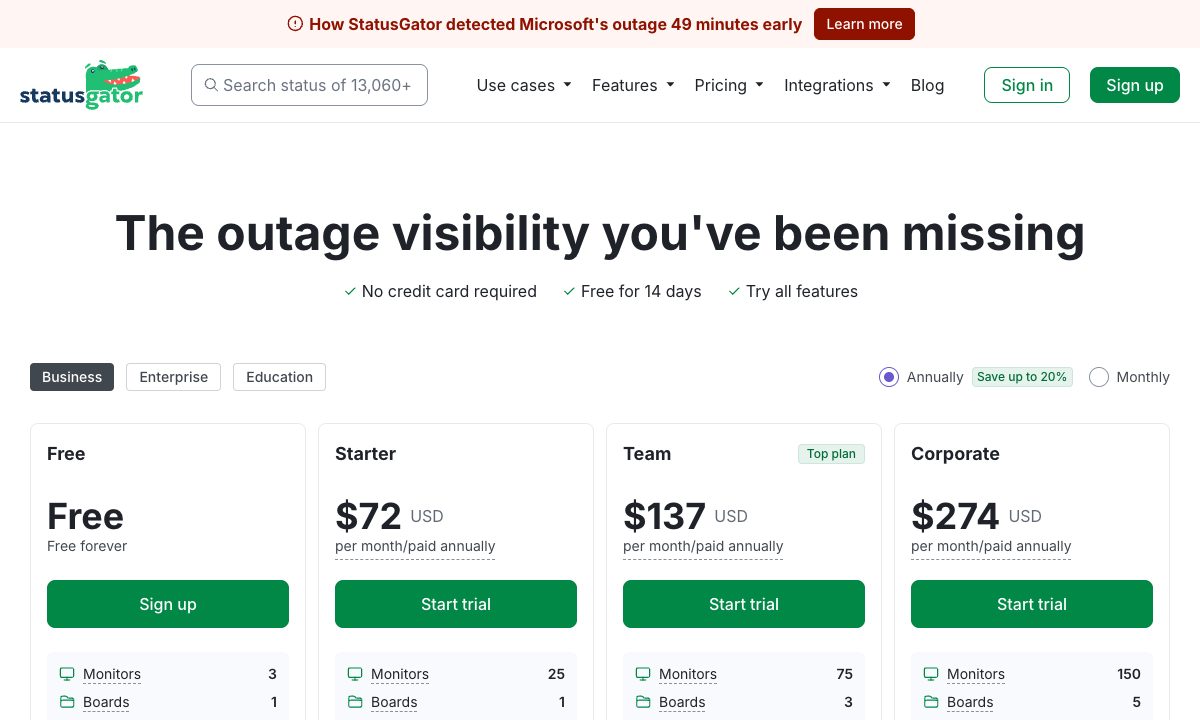
| StatusGator | Status page aggregator | 13,060+ | 3 monitors, 10 notifications a month | $79 a month for 25 ($72 billed yearly) | The widest catalogue and early warnings |
| IsDown | Status page aggregator | 6,320+ in its outage data API | No, 14-day trial | $27 a month for 15 ($22 billed yearly) | Small teams watching key vendors |
| StatusPal | Status page with external services | Not published | No, 14-day trial | $99 a month (Startup) | Showing providers on your own status page |
| Atlassian Statuspage | Status page with third-party components | Not published | Free plan for status pages | $29 a month (Hobby) | Teams already on Statuspage |
Dedicated dependency monitors
1. Pulsetic: best value if you also need uptime monitoring
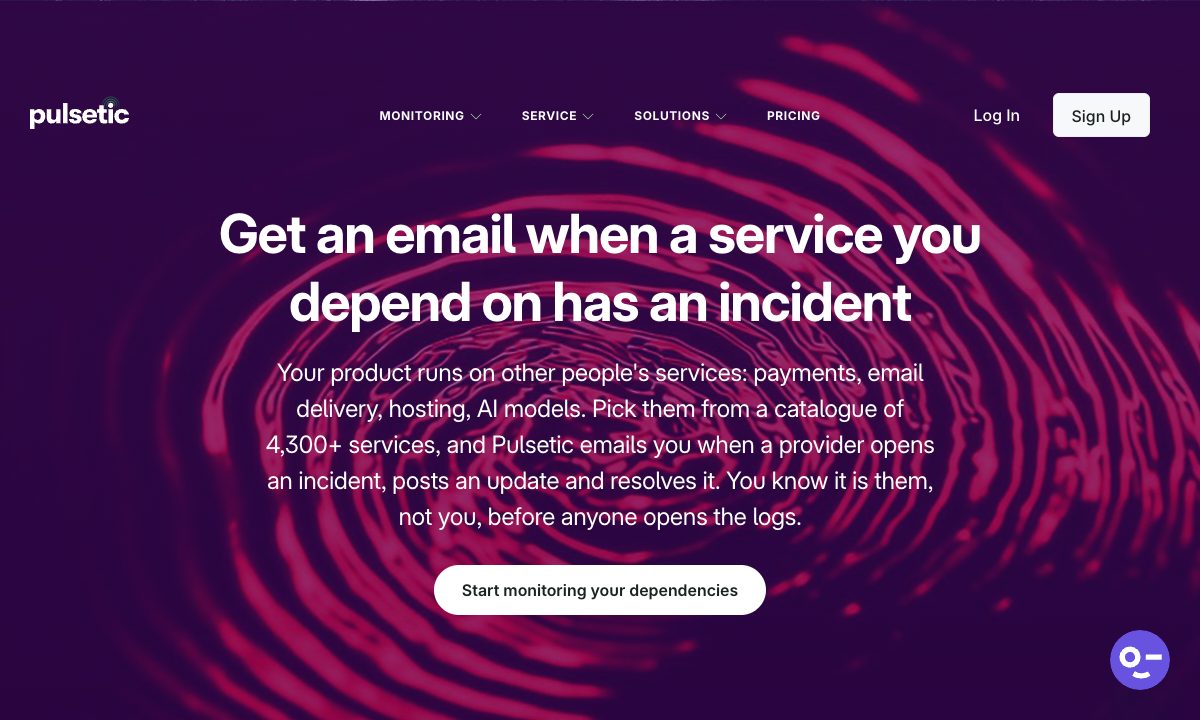
Pulsetic is an uptime monitor with dependency monitors in its plans. You pick services from a catalogue of 4,300+, and Pulsetic emails you when a provider opens an incident, each time it posts an update, and when it resolves the incident. Each dependency gets its own page with a 90-day incident history, the median time to resolve, and response times checked from 15 locations. You can add a dependency to your Pulsetic status page, so customers see the provider's incident next to your own monitors.
Pricing:
| Plan | Monthly | Dependency monitors | Uptime monitors |
|---|---|---|---|
| Free | $0 | 1 | 10 |
| Solo | $9 | 3 | 10 |
| Team | $19 | 10 | 50 |
| Organization | $49 | 30 | 300 |
Extra dependency monitors are $0.20 each a month on any paid plan. Yearly billing saves two months. The first order can be refunded within 20 days.
Limitations: the catalogue is smaller than StatusGator's, 4,300+ against 13,060+. Its dependency page describes email alerts and says nothing about Slack or other channels for dependency incidents. It reports what providers post and makes no early-warning claim. History is 90 days.
Good for: small teams, agencies and SaaS products that need uptime checks on their own site anyway and want their key vendors watched in the same dashboard, for a few dollars a month.
2. StatusGator: best for the largest catalogue and early warnings
StatusGator is a status page aggregator that has tracked services since 2015. Its catalogue covers 13,060+ services. It turns each provider's status into one format (up, down, warn or maintenance), lets you filter alerts by component, region and severity, and sends them to Slack, Teams, PagerDuty, email or webhooks. Its Early Warning Signals feature processes reported incidents, unusual traffic patterns and spikes in user activity every 60 seconds and can alert you before a provider posts on its status page. You can also publish public or private status pages built from the services you follow.
Pricing:
| Plan | Monthly | Billed yearly, per month | Monitors | Users | History |
|---|---|---|---|---|---|
| Free | $0 | $0 | 3 | 1 | 1 month |
| Starter | $79 | $72 | 25 | 1 | 3 months |
| Team | $149 | $137 | 75 | 3 | 6 months |
| Corporate | $299 | $274 | 150 | 10 | 12 months |
The free plan sends 10 notifications a month. Paid plans have unlimited notifications and a 14-day trial with no card.
Limitations: the paid plans cost far more per service than an uptime tool with dependency monitors. It does not check your own site, so you still need an uptime monitor.
Good for: IT, DevOps and managed service teams that rely on dozens of SaaS tools and want warnings before official updates.
3. IsDown: best dedicated aggregator for a small team
IsDown monitors official status pages and shows incident titles, affected components and updates in one dashboard. Its pricing page lists boards, status pages, subscriber limits and an outage data API covering 6,320+ vendors.
Pricing:
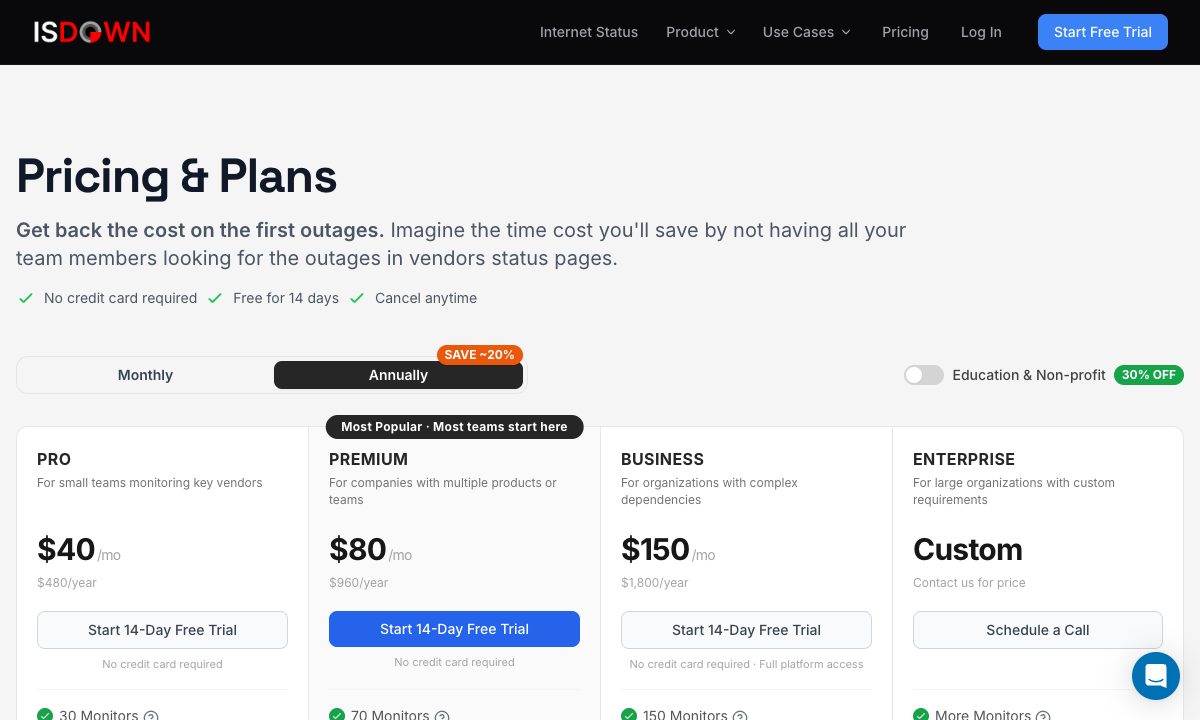
| Plan | Monthly | Billed yearly, per month | Monitors | Admin users | History |
|---|---|---|---|---|---|
| Starter | $27 | $22 | 15 | 1 | Not listed |
| Pro | $49 | $40 | 30 | 2 | 6 months |
| Premium | $99 | $80 | 70 | 5 | 12 months |
| Business | $179 | $150 | 150 | 15 | 24 months |
| MSP | $200, monthly only | 200 | 5 | 24 months |
An add-on gives 20 more monitors and one more board for $15 a month. Starter alerts by Slack and email. Pro and above include all notification channels. Every plan has a 14-day trial with no card, and you can get a full refund within 10 days of subscribing.
Limitations: no free plan. Like StatusGator, it does not monitor your own site.
Good for: small teams that want a dedicated vendor dashboard for less than StatusGator's entry price.
Status pages that show your providers
These are status page tools first. They put a provider's status on your page for your customers. Choose them when that is the main goal.
4. StatusPal: best for showing providers on your status page
StatusPal is a hosted status page. Its "external dependencies" show the status of providers such as GCP, AWS, DigitalOcean and GitHub on your page. When a provider has an outage, StatusPal can reflect it on your page and notify you.
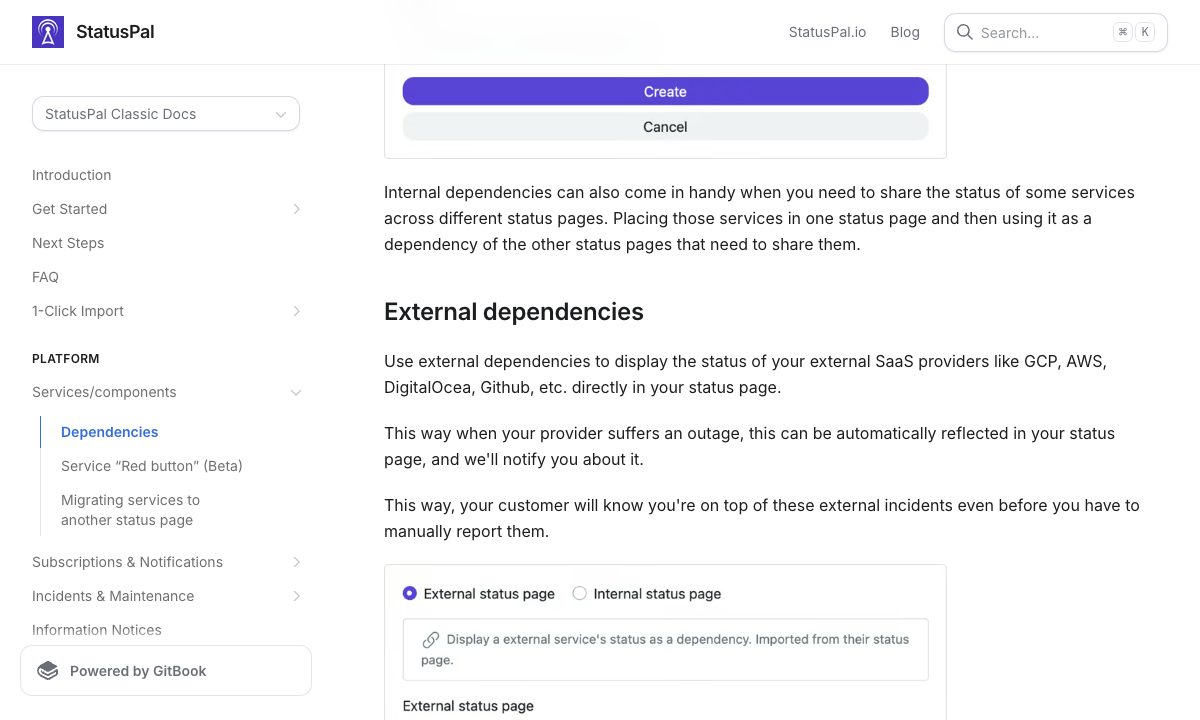
Pricing: external services status is listed on the Startup plan, $99 a month, and above. The Hobby plan, $46 a month, does not list it. Every plan has a 14-day trial with no card.
Limitations: it is a status page product, so the entry price for this feature is high if you only want alerts. StatusPal does not publish how many providers it supports.
Good for: SaaS companies that want customers to see when a provider, not the product, is the cause.
5. Atlassian Statuspage: best if you already use Statuspage
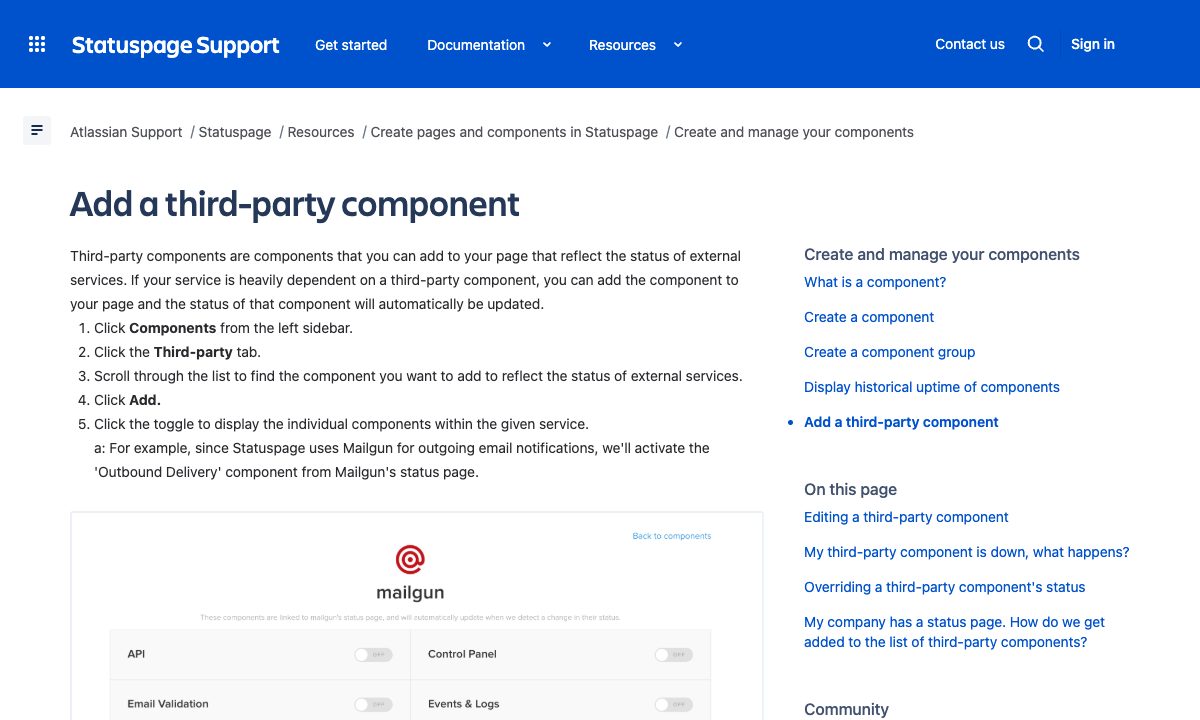
Atlassian Statuspage lets you add third-party components to your status page. You pick a provider from a list and turn on the components you rely on. Statuspage then degrades and restores that component on your page when the provider's own status page changes. You can override the status if a provider incident doesn't affect you.
Pricing: public status pages are free for 100 subscribers and 25 components. Hobby is $29 a month, Startup $99 and Business $399.
Limitations: the list of third-party providers is limited. A company appears in it when its status page admin asks Atlassian support to be listed. The support page describes updating your status page, not alerting your team.
Good for: teams already running their status page on Statuspage.
Which StatusGator alternative should you choose?
- You want uptime monitoring and dependency alerts in one tool: Pulsetic. A free plan to start, then $9 to $49 a month for 3 to 30 dependencies.
- You rely on many SaaS tools and want to hear before the status page updates: StatusGator, for its catalogue and Early Warning Signals.
- You want a dedicated vendor dashboard on a smaller budget: IsDown, from $27 a month.
- Your customers should see provider incidents on your status page: StatusPal from its Startup plan, or Statuspage if you already use it. Pulsetic can also show dependencies on its status pages.
FAQ
What is a status page aggregator?
A tool that reads the status pages of the services you use and shows them in one dashboard, with alerts when one of them has an incident. StatusGator and IsDown are aggregators. Pulsetic offers the same job as dependency monitors inside an uptime monitoring plan.
Is there a free alternative to StatusGator?
StatusGator has a free plan with 3 monitors and 10 notifications a month. Pulsetic's free plan includes 1 dependency monitor along with 10 uptime monitors. IsDown has a 14-day trial but no free plan.
Can these tools alert me before a provider updates its status page?
StatusGator says its Early Warning Signals can, using reported incidents, traffic patterns and user activity, processed every 60 seconds. The other tools here follow what the provider posts, so they alert you when the provider declares the incident.
Do I still need uptime monitoring?
Yes. A dependency monitor tells you when a provider has an incident. It doesn't check whether your own site or API is up. Pulsetic does both. With StatusGator, IsDown or a status page tool, you need a separate uptime monitor.